How to Convert an OPC into a Private Limited Company
In short
An OPC can convert into a private limited company at any time; since the 2021 amendment there is no waiting period and no turnover or capital trigger. It must have at least two members and two directors, pass a special resolution altering its MoA and AoA, file Form MGT-14 within 30 days and then Form INC-6. The Registrar issues a fresh certificate of incorporation in the new name, and the company keeps its PAN, bank account and contracts.
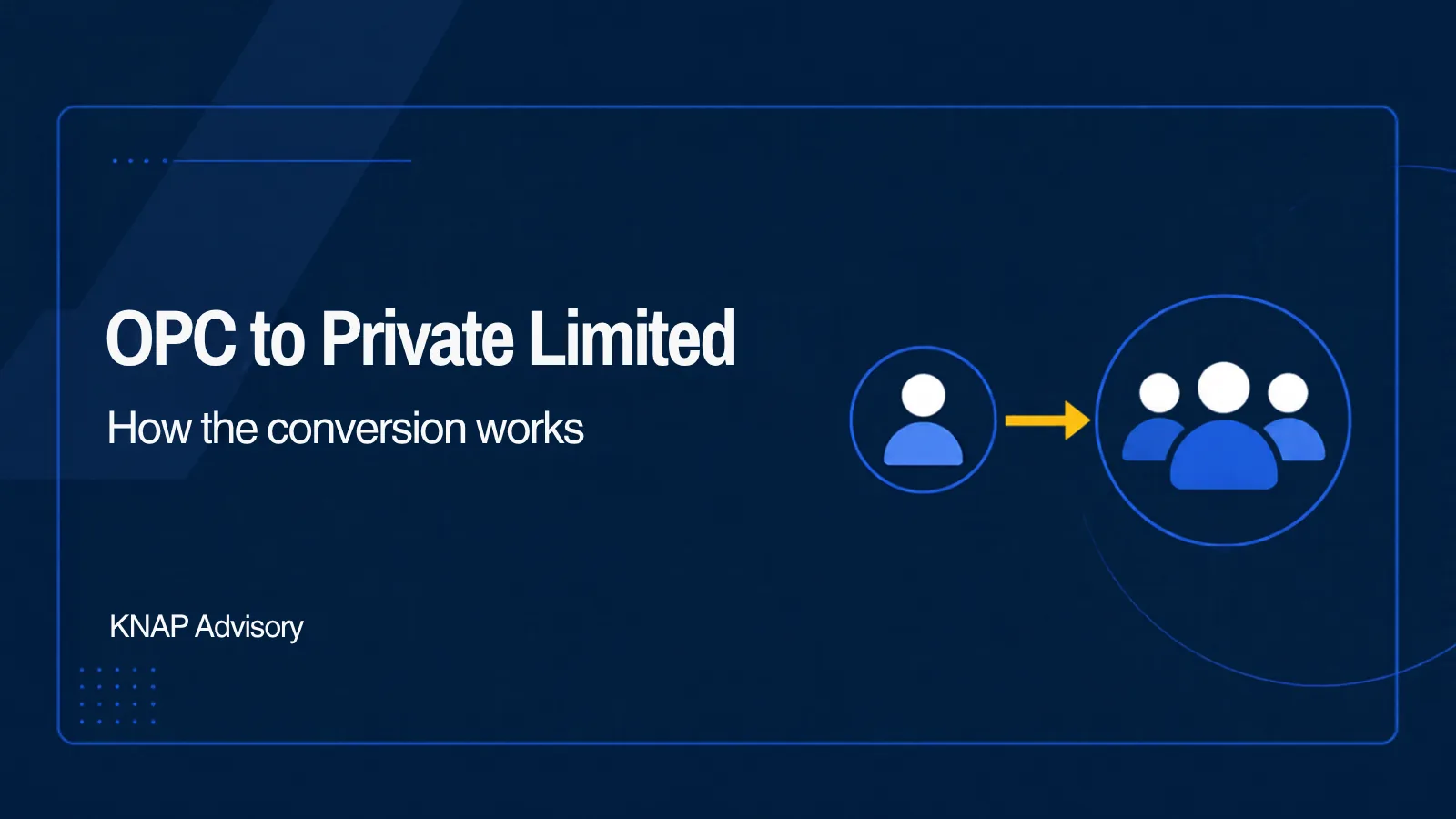
A One Person Company suits a single founder who wants limited liability. It stops fitting when the business brings in a co-founder, raises equity or wants to grant ESOPs, because an OPC can have only one member. At that point the usual step is to convert it into a private limited company.
When can an OPC convert?
Since 1 April 2021, when the Companies (Incorporation) Rules were amended, an OPC can convert voluntarily into a private or public company at any time.
Before that change, an OPC had to wait two years before converting voluntarily, and had to convert compulsorily once its paid-up capital exceeded ₹50 lakh or its average annual turnover exceeded ₹2 crore. Both the waiting period and the compulsory thresholds were removed, so the decision is now a business one.
What the company needs before converting
- At least two members. New members are usually brought in by allotting fresh shares or by the existing member transferring some shares.
- At least two directors. A second director needs a DIN and consent in Form DIR-2, and is appointed by the board.
- Altered charter documents. The MoA and AoA must be altered to remove the one-person-company clauses, including the nominee clause, and to change the name from "(OPC) Private Limited" to "Private Limited".
- Enough authorised capital for any new shares being issued. If not, authorised capital is increased first.
Step-by-step process
- Board meeting. The board approves the conversion, the altered MoA and AoA, and calls for the member's approval.
- Special resolution. The sole member approves the conversion and the alterations by special resolution. In an OPC this is done by entering the resolution in the minutes book and signing it.
- Form MGT-14. The special resolution is filed with the Registrar of Companies within 30 days.
- Form INC-6. The conversion application is filed with the altered MoA and AoA, the resolution, and the details and consents of the members and directors.
- New certificate. Once satisfied, the Registrar issues a fresh certificate of incorporation in the company's new name.
What changes after conversion
The company remains the same legal entity. It keeps its PAN, TAN, bank account, assets, liabilities and contracts. What changes is its name and class: its letterhead, invoices, website, signboard and seal must show the new name, and the bank, GST registration, tax and other registrations must be updated with the new certificate.
As a private limited company it must now hold at least four board meetings a year and file its annual return in Form MGT-7 instead of MGT-7A, unless it is a small company (see MGT-7 vs MGT-7A).
Frequently asked questions
Is there a minimum period before an OPC can convert into a private limited company?
No. Since April 2021 an OPC can convert at any time after incorporation. The earlier two-year waiting period was removed.
Is conversion compulsory once turnover crosses ₹2 crore?
No longer. The compulsory conversion thresholds of ₹50 lakh paid-up capital and ₹2 crore average turnover were removed in 2021. Conversion is voluntary.
Does the PAN change when an OPC becomes a private limited company?
No. The company is the same legal person, so its PAN and TAN stay the same. The PAN record, bank account and other registrations are updated with the new name.
Which forms are filed to convert an OPC?
Form MGT-14 for the special resolution, within 30 days of passing it, and Form INC-6 for the conversion itself. Appointing a second director also needs Form DIR-12, and any share allotment needs Form PAS-3.
How does the company's name change on conversion?
The words "(OPC) Private Limited" are replaced with "Private Limited", so "Sharma Designs (OPC) Private Limited" becomes "Sharma Designs Private Limited". No new name reservation is needed for this change, and the Registrar issues a fresh certificate in the new name.
Who can become the second shareholder?
Any person or entity that can hold shares in a private company, such as a co-founder, family member, investor or another company. A non-resident shareholder can be brought in, subject to FDI rules and FEMA reporting.
How long does it take to convert an OPC?
Usually three to five weeks, covering the second director's DIN, the share allotment or transfer, the special resolution and the MGT-14 and INC-6 filings, and the Registrar's approval.
Is stamp duty payable on conversion?
Stamp duty may arise on the shares allotted or transferred to the new member, and on increasing authorised capital if that is needed. A transfer of shares by the existing member to the new one attracts stamp duty of 0.015% of the consideration.
Does the GST registration need to be updated after conversion?
Yes. The legal name changes, so the GST registration is amended through a core-field amendment with the fresh certificate of incorporation. The GSTIN itself does not change because the PAN stays the same.
Do existing contracts need to be signed again?
No. The company is the same legal entity, so its contracts, licences, loans and assets continue. Inform customers, suppliers and lenders of the new name, and update agreements when they are next renewed.
What happens to the nominee after conversion?
The nominee requirement ends, because it applies only to One Person Companies. The nominee clause is removed when the MoA and AoA are altered, and continuity is then provided by the shareholders.
Does the converted company still get OPC exemptions?
No. It loses OPC-specific exemptions such as not holding an AGM. If it qualifies as a small company, it keeps some relaxations, such as two board meetings a year, filing MGT-7A and not preparing a cash flow statement.
Are there tax consequences when an OPC converts?
The conversion itself has no income tax effect because the company does not change. If the existing member sells shares to the new member, that sale may give rise to capital gains for the seller, so it should be priced with a valuation.
Does the second director need a DIN before conversion?
Yes. The new director applies for a DIN in Form DIR-3, gives consent in Form DIR-2 and is appointed by the board, which files Form DIR-12 within 30 days. This is done before the conversion application.
Does DPIIT recognition continue after conversion?
Yes. Recognition is held by the entity, which does not change, so it continues. The startup should update its name and details on the Startup India portal with the fresh certificate.