Private vs Public Limited Company: Key Differences
In short
A private limited company has at least two members (at most 200) and two directors, restricts the transfer of its shares and cannot invite the public to invest. A public limited company needs at least seven members and three directors, has no upper limit on members, has freely transferable shares and can raise money from the public, in return for stricter governance. Most startups and owner-run businesses start as private limited companies.
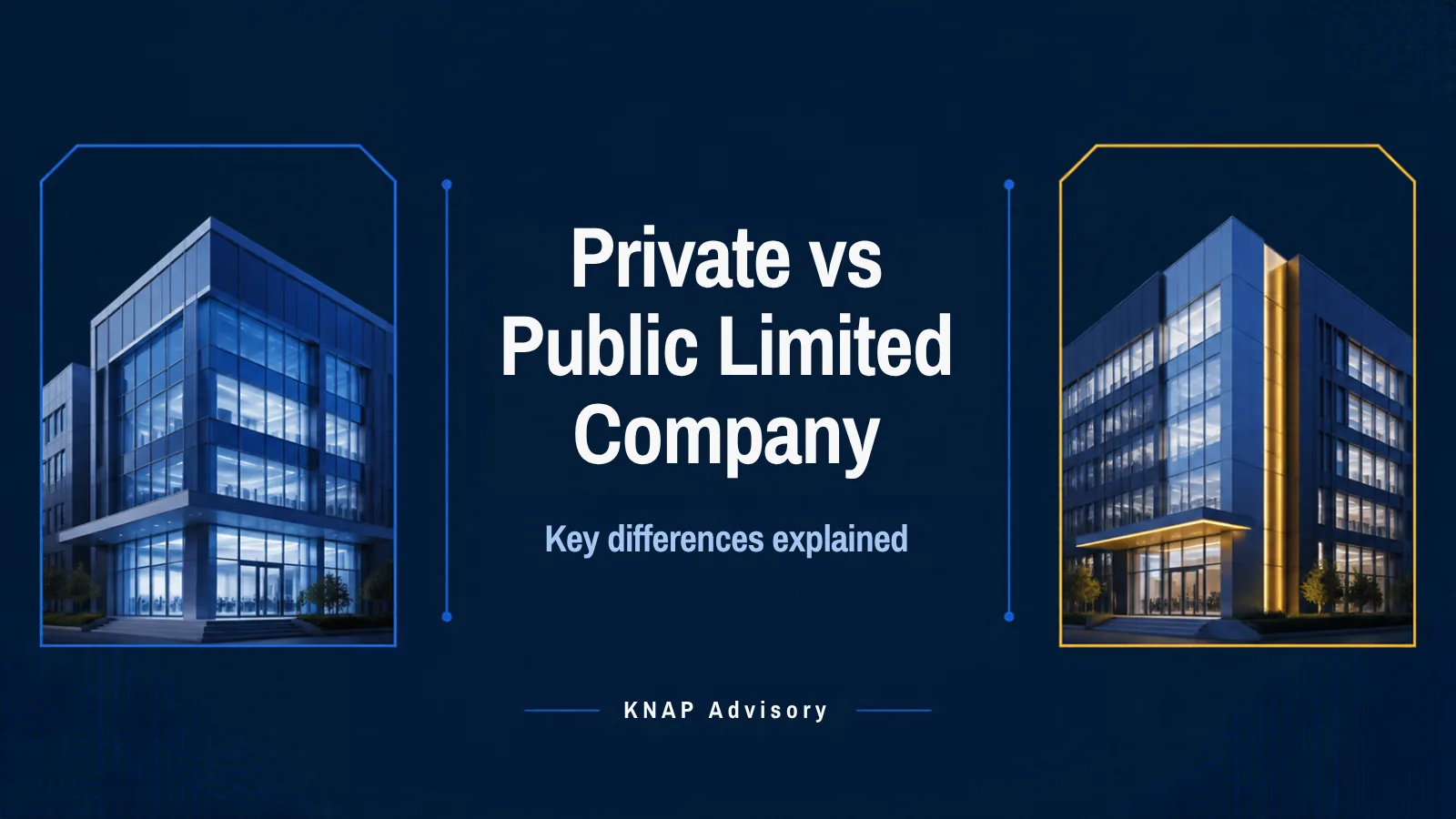
Both are companies limited by shares under the Companies Act, 2013. Both are separate legal entities, both protect their shareholders with limited liability, and both are registered online with the Ministry of Corporate Affairs (MCA) through the same SPICe+ form. The difference lies in who can own the company, how its shares change hands and how it raises money.
What is a private limited company?
A private limited company is one whose articles of association restrict the right to transfer its shares, limit its members to 200 (not counting present and former employees who hold shares) and prohibit any invitation to the public to subscribe to its securities. Its name ends with "Private Limited".
It is the structure most Indian startups, family businesses and professional ventures choose, because it gives limited liability and investor-ready share capital with lighter compliance than a public company.
What is a public limited company?
A public limited company is any company that is not a private company. It needs at least seven members and has no upper limit, its shares are freely transferable, and it can raise money from the public by issuing a prospectus. Its name ends with "Limited".
A public company does not have to be listed on a stock exchange. Listing is a separate step, and a listed company must also follow SEBI's listing regulations. Many unlisted public companies exist, often because they have outgrown the 200-member limit or are subsidiaries of public companies.
Key differences at a glance
| Point | Private limited company | Public limited company |
|---|---|---|
| Minimum members | 2 | 7 |
| Maximum members | 200 (excluding employee shareholders) | No limit |
| Minimum directors | 2 | 3 |
| Name ends with | Private Limited | Limited |
| Transfer of shares | Restricted by the articles | Freely transferable |
| Raising money from the public | Not allowed | Allowed, through a prospectus |
| Independent directors | Not required | Required for listed companies and larger unlisted public companies |
| Quorum for general meetings | 2 members present | 5, 15 or 30 members, depending on the number of members |
| Limits on managerial pay | Not applicable | Apply under section 197 |
| Minimum paid-up capital | None | None |
Governance and compliance
A public company carries more obligations because outsiders can invest in it:
- Unlisted public companies with paid-up capital of ₹10 crore or more, turnover of ₹100 crore or more, or outstanding loans, debentures and deposits above ₹50 crore must have at least two independent directors. Listed companies must have independent directors making up at least one-third of the board.
- Payments to directors and managers are subject to the overall limits in section 197 of the Companies Act.
- Related-party transactions, loans to directors and inter-corporate loans face tighter conditions. Private companies enjoy a set of exemptions from these provisions, notified by the MCA, that public companies do not.
Both types file annual financial statements (Form AOC-4) and an annual return with the Registrar of Companies, hold board and general meetings, and have their accounts audited every year.
Which one should you choose?
Choose a private limited company if you are starting a business with a small group of founders, plan to raise money from angel investors or venture capital funds, or want to offer ESOPs to employees. Investors in Indian startups invest in private limited companies as a matter of course.
Choose a public limited company if you need more than 200 shareholders, plan to raise money from the public or list on a stock exchange in the foreseeable future, or are setting up a subsidiary of an existing public company.
You do not have to decide forever on day one. A private company can convert into a public company later by passing a special resolution, altering its articles and filing the change with the Registrar of Companies, once it meets the requirements on members and directors.
If the organisation will not distribute profits at all, for example a foundation or a school, neither form fits. Compare a Section 8 company, trust and society instead.
Frequently asked questions
Is a public limited company the same as a listed company?
No. Every listed company is a public company, but a public company does not have to be listed. Listing on a stock exchange is a separate decision with its own SEBI requirements.
Can a private limited company have more than 200 shareholders?
No. The limit is 200 members, not counting present and former employees who became members while employed. A company that needs more members has to convert into a public company.
Which is better for a startup in India?
A private limited company, in almost every case. It is the structure investors expect, it can issue ESOPs and it carries lighter compliance. Startups usually convert into public companies only when they prepare for an IPO.
Is there a minimum capital requirement for either type?
No. The minimum paid-up capital requirements for both private and public companies were removed in 2015, so either can be incorporated with the capital the business needs.
Can a public limited company be owned by friends and family only?
Yes. An unlisted public company needs at least seven members, who can be anyone, including family members. It does not have to offer shares to the public at all.
Which type costs more to run?
A public company, because of more meetings, stricter approvals, possible independent directors, committees and secretarial audit at larger sizes. For a small business the difference in annual compliance cost is significant.
Can a private limited company list on a stock exchange?
Not directly. It must first convert into a public company and then meet SEBI's eligibility and disclosure requirements for an IPO.
Can a private company give loans to its directors?
Private companies have a conditional exemption from the restrictions on loans to directors, for example where no other company has invested in their share capital and borrowings are within the prescribed limits. Public companies face the full restrictions.
Do limits on directors' remuneration apply to a private company?
No. The overall limits on managerial remuneration in section 197 apply only to public companies. A private company decides its directors' pay through its board and shareholders.
Can a single company own a public limited company?
A public company must have at least seven members, so a parent company that wants full ownership holds most shares itself and the rest through nominees. It can still be a wholly owned subsidiary in substance.
Are private and public companies taxed differently?
No. Both are domestic companies and pay income tax at the same rates, including the option of the concessional 22% base rate. The difference lies in company law, not tax.
Is a private company that is a subsidiary of a public company treated as public?
Yes, for most purposes of the Companies Act. A private company that is a subsidiary of a public company is treated as a public company, even if its articles retain the private company restrictions.
Which companies need a secretarial audit?
Every listed company, every public company with paid-up capital of ₹50 crore or more or turnover of ₹250 crore or more, and every company with outstanding bank loans of ₹100 crore or more must have a secretarial audit by a practising company secretary.
Do private and public companies have the same board meeting rules?
Both must hold at least four board meetings a year with no more than 120 days between them. A private company that is a small company can instead hold one meeting in each half of the calendar year, a relaxation not available to public companies.
How many investors can a private company bring in?
A private company can have up to 200 members, and any single private placement offer can be made to no more than 200 persons in a financial year, excluding qualified institutional buyers and employees under ESOPs. That is ample for most venture-funded startups.